South Africa is rethinking one of its most familiar milestones: retiring at 65. Economic pressure, longer life expectancy, and shifting labour needs are driving a reset that could reshape how and when people exit the workforce. For many South Africans, retirement has never been a simple switch from work to rest, and this new direction reflects that reality. The conversation now goes beyond age alone, touching on income security, flexible employment, and fair access to pensions in a country where inequality and unemployment remain central challenges.

South Africa retirement age changes and what they mean
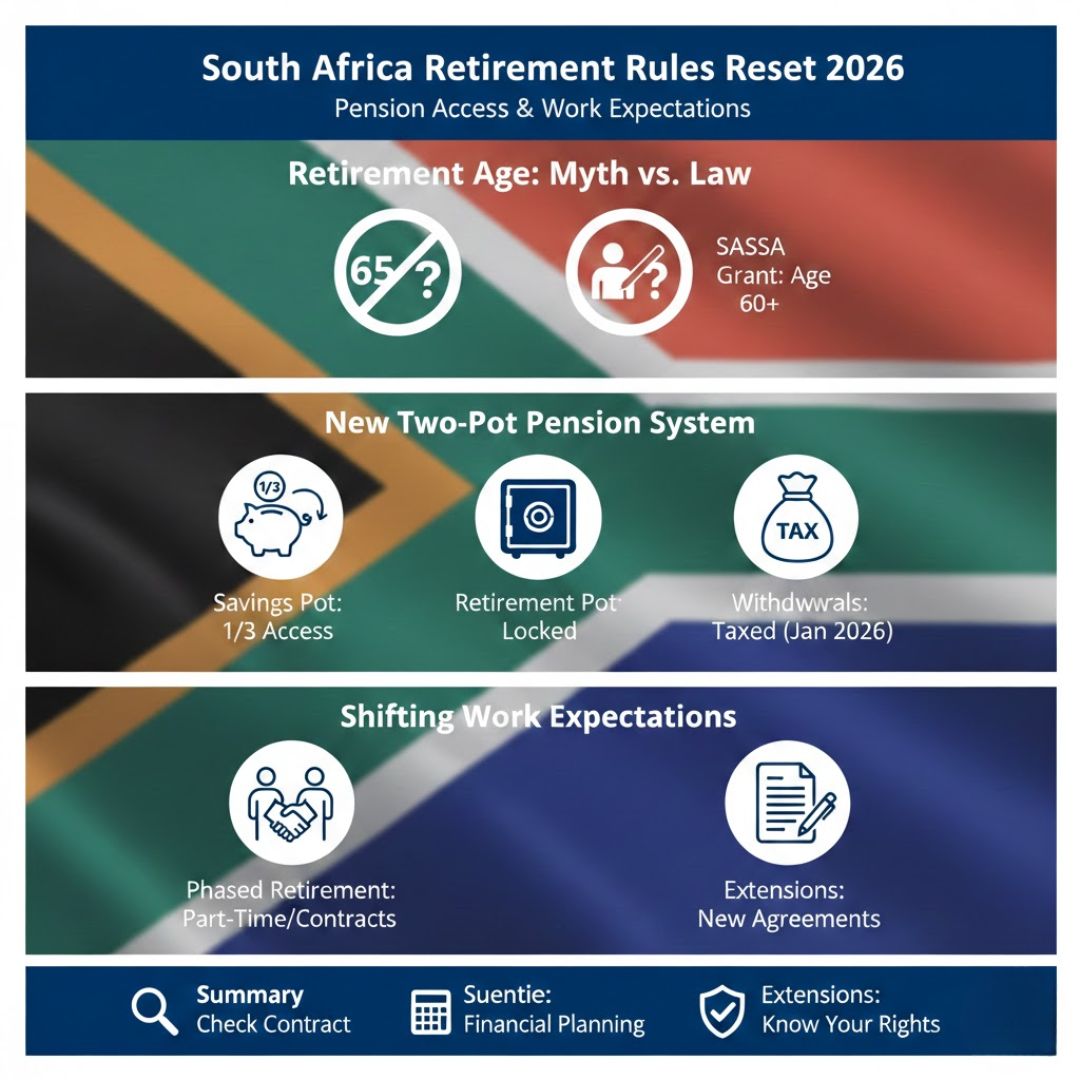
The move away from a fixed retirement age signals a more flexible approach to working life. Instead of a hard stop at 65, policies are leaning toward choice, capacity, and financial readiness. This shift responds to longer working lives, rising healthcare costs, and the fact that many citizens cannot afford to stop earning suddenly. Employers are also adapting, creating roles that suit age-diverse workplaces and value experience. While not mandatory for everyone, the change reframes expectations around retirement age flexibility, encouraging gradual transitions rather than abrupt exits. For workers, it opens space to plan more realistically based on savings and health.

Pension access rules under the new retirement age reset
Pension access is closely tied to this reset, as eligibility is no longer viewed purely through an age lens. Instead, authorities are considering contribution history and need, aiming for fair pension access across income groups. This is especially relevant for informal workers and those with interrupted careers. Adjustments could improve grant eligibility clarity and reduce confusion around when benefits begin. At the same time, safeguards are needed to protect vulnerable retirees who rely on state support systems. The broader goal is a system that balances sustainability with dignity for older citizens.
Work expectations for older employees in South Africa
As retirement norms evolve, so do expectations at work. Older employees are increasingly seen as assets rather than placeholders. Companies are experimenting with part-time roles, mentoring positions, and project-based contracts that suit experienced workers value. This approach supports skills transfer opportunities while reducing pressure on younger jobseekers. However, it also raises questions about workplace age balance and fair progression. Success will depend on cooperation between employers, unions, and policymakers to ensure flexibility does not become exploitation.
Summary and broader impact analysis
Ultimately, South Africa’s retirement age reset reflects deeper economic and social realities. A single age threshold no longer fits a diverse population with unequal access to savings and stable employment. By promoting retirement planning freedom, the shift encourages individuals to make choices aligned with their circumstances. Still, careful oversight is essential to prevent gaps in protection. If managed well, the changes could strengthen economic participation longevity and ease strain on public finances. If handled poorly, they risk widening inequality among older citizens.
| Aspect | Previous Approach | Current Direction |
|---|---|---|
| Retirement age | Fixed at 65 | More flexible range |
| Pension access | Age-based | Needs and contributions |
| Work options | Full exit | Phased retirement |
| Employer role | Limited flexibility | Adaptive contracts |
| Policy focus | Uniform rules | Individual circumstances |
Frequently Asked Questions (FAQs)
1. Is retirement at 65 still required?
No, the new approach allows more flexibility based on circumstances.
2. Does this affect state pensions?
Yes, pension access is being reviewed alongside retirement age rules.
3. Can older workers stay employed longer?
Many employers are now offering flexible or phased work options.
4. Who benefits most from the reset?
Workers with limited savings or disrupted careers may gain the most.